From Scheme to Murder
Why My Second Book Had to Have a Body

When I wrote The Scheme, I made a deliberate choice: no dead bodies.
This wasn't because I was squeamish about writing murder, or because I couldn't think of a good killing. It was because I wanted to prove something to myself and to readers about what crime fiction could be.
Most crime in real life doesn't involve murder. People embezzle money, commit fraud, engage in corporate espionage, run elaborate cons, and break hearts along with laws. These crimes have real victims and serious consequences, but they don't end with someone in a body bag. So why do so many mysteries default to murder?
The Non-Murder Experiment
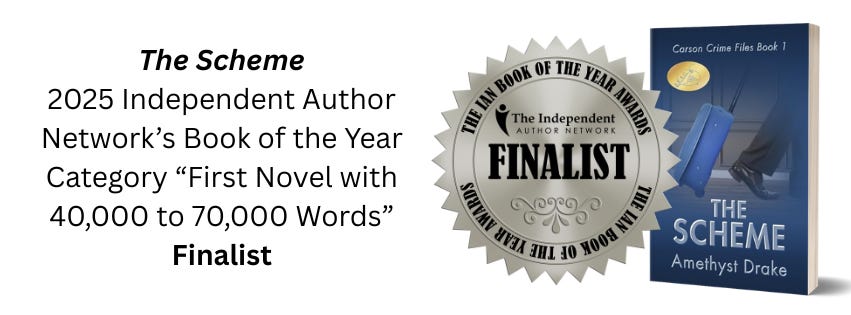
"The Scheme" was my attempt to explore the vast landscape of crime beyond homicide. I wanted Katherine Carson's first recorded case to showcase different detective skills like pattern recognition, deductive reasoning, and good old fashioned persistence.
The Scheme dealt with fraud, identity theft, and financial manipulation. The stakes were high—people's life savings, their sense of security, their ability to trust—but nobody died. Katherine could use her interrogation skills to uncover lies, her investigation experience to follow complex paper trails, and her team's diverse expertise to solve a puzzle that was no less intricate for lacking a corpse.
I loved writing that story. It felt fresh and different, and it proved that Katherine Carson could anchor a compelling mystery without anyone getting murdered.
But reader reactions were... mixed.
Here’s what I learned from The Scheme: mystery readers carry decades of genre training, and bucking those expectations comes with a cost.
Some readers embraced the unconventional approach, but an equal number kept anticipating the body drop. They’d been conditioned by countless mystery novels to expect specific escalations, particular stakes. When those elements never showed up, some readers were disappointed.
“Well it isn’t a murder mystery,” I’d respond, but the explanation didn’t erase the disconnect. Readers choose mysteries anticipating specific thrills, particular flavors of danger. When you intentionally deny those elements, you’re asking them to reset their mental framework halfway through.
Their reaction isn’t unreasonable. Genre fiction works partly because of its reliable expectations. Romance readers crave the relationship payoff. Thriller readers hunt for adrenaline-pumping sequences. Mystery readers want the ultimate puzzle: who killed whom and why?
Why Framed Needed a Body
I always planned for Book 2 to be a murder mystery. Because like many readers, I am a fan of all the murder mystery tropes.
More importantly, Katherine’s character arc demanded it. As a former intelligence operative who lost her husband Daniel to violence, Katherine needed to confront the ultimate crime. Her grief, her guilt, and her determination to protect other widows like Misty Vanderlin—all of these elements required the gravity that only murder provides.
Writing murder mysteries versus non-murder crime fiction presents distinct challenges. With The Scheme, I had to work harder to maintain tension without the ticking clock of a killer on the loose. I had to make financial crimes feel as urgent as physical danger. I had to create emotional stakes that matched traditional mysteries' life-and-death situations.
With Framed, I faced different obstacles. How do you make a murder feel fresh in a genre saturated with bodies? How do you honor reader expectations while still surprising them? How do you balance the familiar pleasure of a classic whodunit with your own desire to innovate?
The answer came in the form of a specific setting and a unique character backstory. Katherine's espionage background and the art world's sophisticated facade let me give Framed distinctive elements within the familiar murder mystery structure.
What I've learned is that series evolution is about finding the balance between reader expectations and innovative thinking. The Scheme proved I could write compelling crime fiction without defaulting to murder. Framed proved I could write murder mysteries that felt personal and fresh.
As I plan future books, I'm not limiting myself to either murder or non-murder crimes. Some cases will demand bodies; others will demand different stakes entirely. What matters is matching the crime to the story Katherine needs to tell.
After all, the best mysteries aren't just about meeting genre expectations.
They're about exceeding them.
Happy Reading! Amethyst Drake
Award Announcement